
Beating the NFL Market With Draft and Simulation Data
NFL markets have become increasingly data-driven, leaving less room for bettors to rely on narratives, last season’s record, or headline roster moves.
The more interesting opportunities often emerge when new information changes a team’s underlying probability faster than the market adjusts.
Draft capital and simulation models can help identify those gaps. Rather than asking whether a team “won the offseason,” bettors can estimate how individual roster changes affect win probability, playoff chances, divisional races, and longer-term futures. Prediction markets add another layer by providing continuously changing probability estimates that can be compared against independent models.
The objective is not to predict every NFL game correctly. It is to find situations where the probability implied by the market differs enough from a data-driven estimate to create a potentially favorable price.
Draft Data Can Reveal More Than Rookie Hype
The NFL Draft creates one of the largest information shocks of the offseason. Teams add players at different positions, trade future assets, address weaknesses, and sometimes reveal their strategic priorities through the amount of draft capital they are willing to spend.
For NFL betting, the mistake is treating every first-round selection as equally valuable. A highly drafted quarterback can materially alter a franchise's long-term distribution of outcomes, while a first-round player at a less influential position may have a much smaller immediate effect on expected wins.
That difference matters because public markets can react heavily to recognizable names. A team selecting a prominent quarterback may attract immediate attention even when that player is unlikely to start early in the season. Conversely, a team quietly improving its offensive line, secondary, or pass rush across several picks may receive less attention despite potentially improving its overall efficiency.
Historical draft data can therefore be converted into expected contribution rather than evaluated through draft grades alone. Pick number, position, age, college production, athletic testing, projected playing time, and historical performance of comparable prospects can all feed into an estimate of rookie impact.
The result is a more useful question: how much did the draft actually change the team's expected performance?
Simulation Models Turn Roster Changes Into Probabilities
Once roster adjustments are quantified, simulations can translate them into outcomes that are directly comparable with betting markets.
A basic NFL simulation might begin with offensive and defensive efficiency ratings before adjusting for quarterback quality, injuries, offseason acquisitions, rookies, coaching changes, and schedule difficulty. Thousands of simulated seasons can then generate distributions for wins, playoff qualification, division championships, conference titles, and the Super Bowl.
Suppose a model runs 100,000 seasons and a team wins its division 31% of the time. If the available market price implies only a 23% probability, the difference is potentially meaningful.
The calculation itself is straightforward: Model edge = estimated probability − market-implied probability
In this example, the model identifies an eight-percentage-point gap. That does not guarantee a profitable trade. It simply suggests the bettor's assumptions differ materially from those embedded in the current price.
This is where simulations become more useful than a single projected record. Saying a team should finish 10-7 hides considerable uncertainty. A simulation can show how frequently that same roster finishes 12-5, misses the playoffs entirely, or wins its division.
Prediction Markets Provide a Real-Time Benchmark
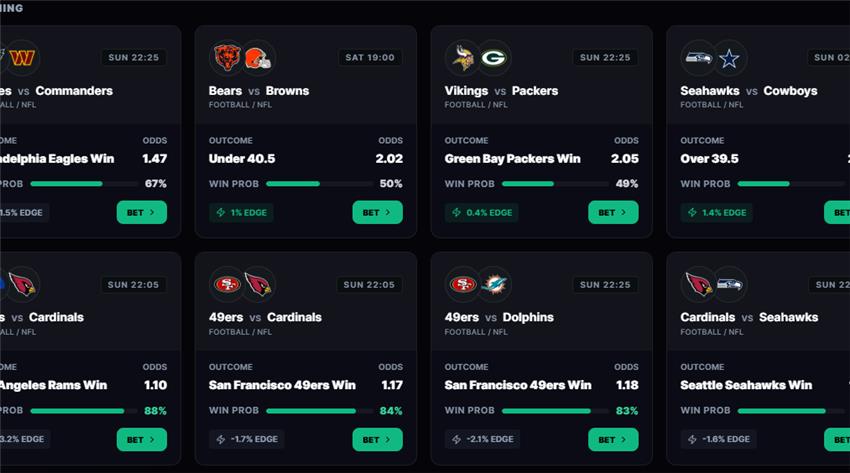
Platforms such as Polymarket and Kalshi make this approach particularly interesting because their contracts are expressed in probability-like prices. A contract trading around 35 cents can broadly be interpreted as the market assigning roughly a 35% chance to the specified outcome, before considering trading frictions and market structure. That makes comparison with simulation output relatively intuitive.
If an independent model gives an outcome a 44% probability while a prediction market prices it around 35%, there is a nine-point disagreement to investigate. If the model estimates 37%, however, the apparent difference may be too small to justify a position once uncertainty and execution costs are considered.
Source: WagerBeasts
Prediction-market aggregators can make this process more efficient by displaying prices from multiple venues together. Instead of evaluating a probability in isolation, traders can see whether disagreement exists between platforms and whether their own simulation sits outside the broader market consensus.
The aggregator data is therefore most useful as a benchmark rather than as the forecast itself. The model provides the independent estimate. The market shows the price required to express that view.
Where Draft-Based Models Can Find Mispricing
The period immediately after the draft is particularly useful because markets must process a large amount of new information simultaneously.
Quarterback situations offer the clearest example. A rookie quarterback may improve a team's ceiling while also widening its range of possible outcomes. A deterministic forecast might simply increase expected wins, whereas a simulation can assign probabilities to the rookie becoming an immediate above-average starter, performing near replacement level, or struggling badly.
Schedule interaction also matters. A team that strengthens its pass defense may gain more than the average model expects if its upcoming schedule is unusually heavy on strong passing offenses. Likewise, an improved offensive line can have disproportionate value for a team with an inexperienced quarterback or an offense heavily dependent on play action.
Depth can be another underappreciated variable. Drafting several competent players may have limited effect on a team's Week 1 power rating, but it can improve resilience over a 17-game season. Models that account for injury probabilities and replacement-level performance may therefore value deep draft classes differently from markets focused primarily on star additions.
Simulations Are Only as Good as Their Assumptions
A model disagreement is not automatically a market inefficiency. NFL outcomes depend on variables that are difficult to forecast, including injuries, player development, coaching adjustments, turnovers, weather, and late-season motivation. Rookie projections introduce even greater uncertainty because college performance does not translate cleanly to professional production.
Simulation results should therefore be treated as probability ranges rather than precise truths. A model showing a 42.3% playoff probability does not genuinely possess tenth-of-a-percentage-point certainty.
One solution is to run multiple scenarios. A rookie quarterback, for example, can be modeled under bearish, base-case, and bullish efficiency assumptions. If the team still appears undervalued under the conservative scenario, the signal is considerably stronger than an edge that exists only under optimistic assumptions.
Model calibration is equally important. If teams assigned a 60% probability by the model historically achieve the relevant outcome only 50% of the time, the simulation is systematically overconfident. Backtesting against previous NFL seasons can reveal these weaknesses before real capital is exposed.
Market Movement Can Be Data Too
The price itself also contains information. If a model assigns a team a 30% probability of winning its division while the market trades at 22%, the initial eight-point gap appears attractive. If the market subsequently moves toward 28% without significant public news, that change may indicate other participants reached a similar conclusion.
The opposite deserves attention as well. If a supposedly undervalued contract keeps falling after the draft, bettors should check the latest NFL news for injuries, depth-chart development, contract disputes, or other information.
Rather than treating market prices as an opponent to defeat, sophisticated models can use them as another input. The strongest signals may occur when independent draft analysis, simulations, and market behavior all point in the same direction.