
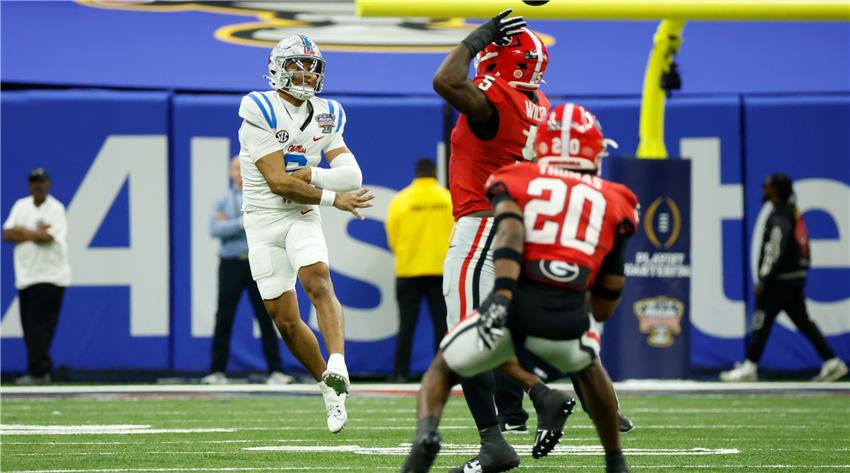
Heisman Odds vs. 2027 Draft Odds: Why Prices Split
Jeremiah Smith, Drew Mestemaker and Darian Mensah get different prices in Heisman and No. 1 pick markets. Here's why the two lines split.
Heisman Futures vs. Draft Futures: Why the Same Player Gets Two Different Prices
Jeremiah Smith is the favorite for the 2027 No. 1 pick. He is not the same kind of favorite for the Heisman. Same player, same season, same film, and two markets that disagree about how much he is worth.
That gap is the most interesting thing on the board right now. And it explains more about how awards and drafts work than any single mock.
Two trophies, two different questions
The Heisman asks a college question: who was the most compelling player in the country this fall? The No. 1 pick asks an NFL question: who gives a franchise the highest return over the next decade?
Those sound close. They aren't.
A Heisman voter watches Saturday afternoons, sees the highlight reels, and responds to a story. Production, team record, a signature win in primetime. A general manager watches All-22 tape, reads medical reports, and looks at what a position is worth in a salary-cap league. One group votes on narrative. The other bets a franchise on projection.
So when the same name shows up in both markets, the two prices are answering different questions. Smith is the cleanest example. At Ohio State he is a wide receiver whose tape grades like a once-a-decade talent, which is why he leads the draft market. But receivers rarely win the Heisman, because the voting habit leans toward quarterbacks and running backs who touch the ball on every snap.
Three players, three different gaps
Take the three names that keep surfacing at the top of both lists.
Jeremiah Smith. Draft side: favorite, with Covers listing a prediction-market probability around 30% for the No. 1 pick as of October 20. Heisman side: a contender, but priced like one, not like a lock. The position works against him in a vote even when it works for him in a scouting room.
Drew Mestemaker. He is closing fast in the draft market, sitting near 25% in that same Covers snapshot. Quarterback is the position that gets rewarded in both places, so his two prices sit closer together than anyone else's. When the player at the premium position has a big season, both markets move in the same direction.
Darian Mensah. This is where it gets awkward. Mensah's college production and team narrative make him a legitimate Heisman name. His draft case depends more on how scouts grade the next layer of the quarterback class, and the quarterback rankings are crowded enough that a strong Heisman push does not automatically translate into a top-pick price.
Notice the pattern. Position and team context drive one line. Pure projection drives the other.
Why the lines actually diverge
Four forces do most of the work.
Voter narrative versus scouting grades. Heisman ballots reward a story arc. A midseason signature game can swing the award market by a full tier. Draft grades barely move on one game, because evaluators are already working from a full body of tape.
Team context. A Heisman candidate on a 12-0 team gets a bump that a draft board ignores. Scouts will happily rank a player on a middling roster at the top, because the roster is not the thing being drafted.
Positional value. The NFL pays quarterbacks and premium pass rushers more than almost anyone, so those positions get a structural lift in draft futures. The Heisman has no salary cap, just a long habit of favoring skill positions that fill a stat sheet.
Timing and eligibility. This one is easy to miss. A Heisman price resolves in December. A draft price resolves next April, after a combine, medicals, and the declaration decision. NIL money has changed that last step, and a former agent has argued that NIL deals are keeping top prospects in school longer. Dante Moore's choice to return to Oregon is the kind of example that shows why a draft line carries risk a Heisman line never has. A player can win a trophy and still not be in the pool.
What history says about the overlap
Here is the sobering part. Heisman winners are not automatic top picks, and top picks are not automatic Heisman winners. The NCAA keeps a running list of every Heisman winner taken first overall, and it is a short one relative to the number of trophies handed out.
In 2024, the Heisman went to a quarterback who was not the consensus top pick on every board. That is the whole thesis in one sentence. The two honors correlate, but they are not the same thing, and any bettor treating them as interchangeable is paying for a link that is thinner than it looks.
If you want to see how the scouting side actually orders these names, the big board is the place to compare against the award odds. And if you want to check how a single prospect is graded, Jeremiah Smith's profile shows the tape-based case behind the draft price.
Where readers can actually act on these futures
Knowing why two prices differ is one thing. Doing something with it is another, and that depends heavily on where you live.
The legal picture in the United States is a patchwork. Some states run full retail and mobile markets. Others allow only retail. Others allow nothing. And the most striking hole on the map is the biggest one: Texas, home of Longhorns prospects like Colin Simmons and a state with an enormous college football audience, still has no legal sportsbooks. Lawmakers have pointed toward the 2027 legislative session as the next real chance, and in the meantime fans there lean on prediction markets and daily fantasy.
That leaves a lot of readers following the Heisman and No. 1 pick races closely with no obvious place to engage with the numbers. For anyone in that position, https://betanews.com/us/texas-sports-betting-sites/ walks through which options Texas residents can actually use right now and where the legal line currently sits.
How to read the two boards together
Strip away the betting angle and the comparison is still useful for anyone who just follows the sport.
When a player's Heisman price is much shorter than his draft price, the market is telling you the college story is stronger than the pro projection. When it flips, the scouts like him more than the voters do. Neither is wrong. They are measuring different things.
The most telling cases are the ones where the gap is widest. A receiver with elite tape and a modest Heisman line. A quarterback with a loud Heisman push and a crowded draft path. Those are the names worth watching through the fall, because the gap tends to close as the season gives one side new information. For the full order of what's at stake, the 2027 draft order shows which franchises are actually positioned to pick first.
Here is the practical takeaway. Don't ask which price is right. Ask which question each price is answering, and whether you trust the answerer.
FAQ
Why isn't the Heisman favorite always the No. 1 pick favorite?
They reward different things. Heisman voters respond to production, team success and storyline, while draft evaluators grade projection, positional value and medicals. A receiver or lineman can dominate scouting boards yet trail quarterbacks and running backs in the award race.
Do quarterbacks have an edge in both markets?
Usually, yes. The Heisman has long favored quarterbacks, and the NFL pays them more than any other position, which lifts their draft value. That is why quarterback prices tend to sit closer together across the two markets than prices for other positions.
Can a player win the Heisman and still miss the top of the draft?
Absolutely. Winning a college award does not change a prospect's size, athletic profile, or positional value. Several winners have gone well outside the first pick, because front offices evaluate what a player will become, not what he just did.
How does NIL affect draft futures?
It adds uncertainty. Top prospects can earn serious money staying in school, so declaration decisions are less predictable than they used to be. A player priced as a top pick may simply not enter the draft, which a Heisman line never has to account for.
When do the odds usually move the most?
Heisman prices swing on big games and midseason narratives. Draft prices tend to move around the combine, pro days, and the declaration deadline, when new athletic data and medical information finally arrives.