
How NFL Teams Build Their Draft Boards
They start with 1,300 names. By April, they might need around 200. That cut happens after eight months of arguing, studying film, travelling between campuses on planes, and a medical check in Indianapolis that can ruin a player's whole year of work in about forty minutes.
Most fans think the NFL Draft starts in February, when the Combine takes place. It doesn't. The path to the draft is a year-long, argument-filled marathon. The Combine is just the loudest part — the one with cameras and stopwatches and everyone watching a guy run forty yards. The real work started in August the previous year, in gyms and film rooms that nobody cares about.
How NFL Teams Build Their Draft Boards Step by Step
|
Phase |
When |
What Happens |
|
School calls and film review |
August–November |
Scouts visit campuses, watch practice, file weekly reports |
|
First preliminary board |
December |
Positions ranked top to bottom in group meetings |
|
All-star games |
January |
Senior Bowl — first time scouts see prospects against each other |
|
NFL Scouting Combine |
February–March |
Medicals run on 300+ players simultaneously — this is the real purpose |
|
Pro days |
March–April |
University workouts, cognitive tests, final data collection |
|
Final board locked |
Late April |
GM, head coach, scouting director agree on one stack |
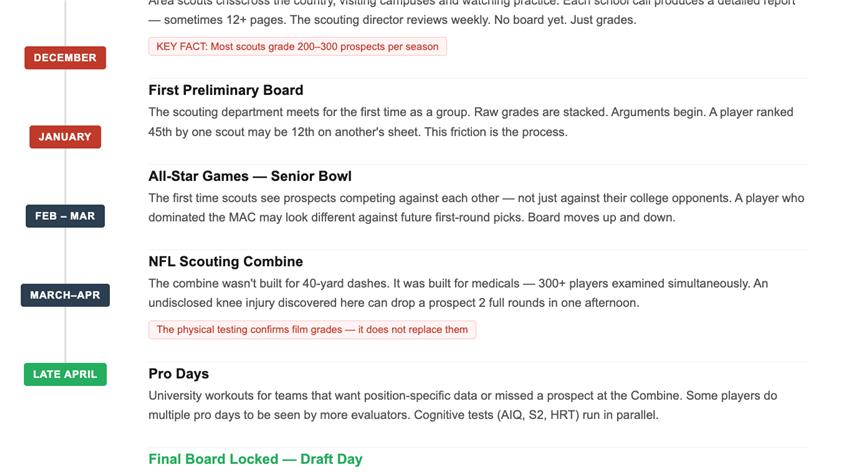
The table above shows the basic steps. Below is the same timeline, but with more of the friction and detail that actually happens inside team facilities. This includes arguments, medical surprises and constant name changes.
What Does an NFL Scout Actually Do All Year?
During the season, scouts travel around to visit schools. After each visit, they send in a full report on every player they saw. We're talking in-depth reviews. Who can improve the team by moving players to different positions? The video doesn't show the background. Questions about his personality, past injuries, and how he reacts when his team is losing by a lot.
A scout might grade 200 players during a season. Some of these reports are twelve pages long. Most fans have never read one. The scouting director reads all of them every week, and by December he has a good idea of the class before anyone starts arguing about who goes where. Even dedicated NFL fans who follow the process closely — including those placing bets on draft outcomes through platforms like JabulaBets — rarely see this level of detail.
The finished board is much more focused than most fans realise. You start with 1,300 names. Finally, you will have a list of players that your team would choose. That's about 150, or maybe 200. Everyone else gets cut — not because they're bad, but because they don't fit your scheme, your needs, or your medical standards.
That last part is more important than people think.
What Really Happens at the NFL Scouting Combine?
Here's the thing most fans get wrong about the Combine. It wasn't built for the 40-yard dash. It was built because running medicals on hundreds of players simultaneously in one place is cheaper and faster than doing it one by one. The physical testing came later. The spectacle came even later than that.
When a highly-rated linebacker walks into the medical room and the doctors find something in his knee that wasn't on any report — that changes things fast. He might drop thirty spots in one afternoon. Medical grade is one of the most important pieces of information that goes on a player's card on the board. Teams hold their breath in that room. A clean medical on a player they love is a genuine relief. A bad one on a player they've watched all year is a gut punch.
The 40 time is fine. We watch it like everyone else. But the teams making the picks are looking at the medical results first.
How Do Teams Use Data and Analytics Now?
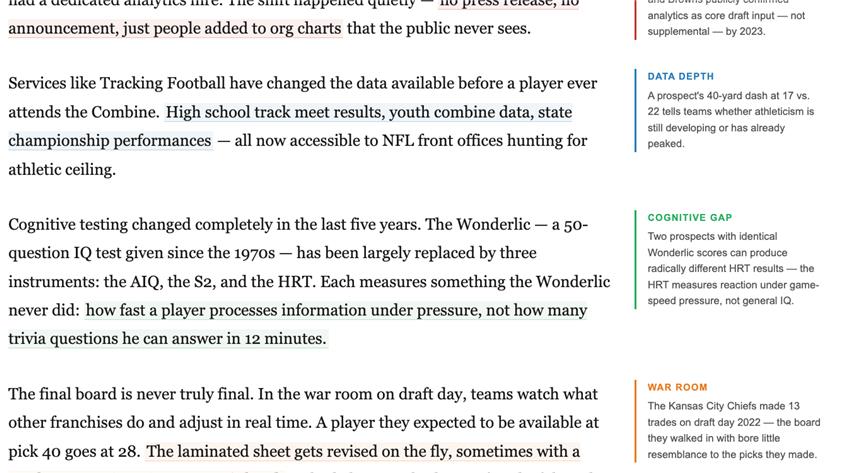
Over the last five years, the view of what cognitive testing should be has changed completely. The old Wonderlic test — fifty questions, twelve minutes, mostly IQ-adjacent stuff — is basically gone now. Teams moved to three tools: the AIQ, the S2, and the HRT. Each one tests something different. Not how smart a player is in the general sense. How fast he reads information under pressure. How he handles a new play call with thirty seconds on the clock.
Some teams use analytics mainly to find which players scouts should watch. Others use the data to rank players alongside the film grade. And some use it as a risk check — what does this player's profile say about his chances of making it in the NFL.
The Cowboys, Eagles, Ravens, Vikings, and Browns are open about how much they lean on their analytics departments. Most other teams do the same and just don't talk about it.
Why No Two Teams Have the Same Board
Every board is held in secret. Teams use colors and symbols to mark different concerns — a red cross for injuries, a yellow dot for off-field issues, a skull and crossbones if a player has a difficult agent. Some prospects end up covered in symbols. They call them "rainbow players." That's not a compliment.
A player one team has at 14th overall might sit at 31st on another team's board. Same player, same film, same Combine. But one team runs a 4-3 defense and the other runs a 3-4, and the linebacker who's perfect for one scheme is a square peg for the other. In every pre-draft meeting we had, the room talked about how a player fit the scheme and what his contribution would look like in years one, two, and three. It's not a talent ranking. It's a fit ranking.
That's the part that doesn't translate to mock drafts, by the way. Fans rank players by talent. Teams rank them by fit, medical status, character, cognitive results, and scheme. The boards look nothing alike.
What determines a player's final position on the board:
-
Film grade from the scout who watched him all year
-
Medical clearance at the Combine — a bad result moves him down fast
-
Scheme fit for how this specific team plays
-
Background and character checks from coaching contacts
-
Cognitive test results — AIQ, S2, HRT
-
Physical testing that confirms or contradicts the film grade
The Board Changes on Draft Day Too
Here's what nobody talks about. You lock the board on Thursday morning. By Thursday afternoon, other teams are making picks and the players you expected to be available at pick 22 are already gone. The smartest teams try to remove their own bias and work out what other teams will do based on past drafting patterns and scheme changes. They war-game it. They model it. And then it still goes sideways.
The Kansas City Chiefs made thirteen trades in one draft. The board they carried into that room looked nothing like the picks they came out with.
Nobody has ever built a perfect draft board. They just keep building new ones every year, and arguing about the last one.