
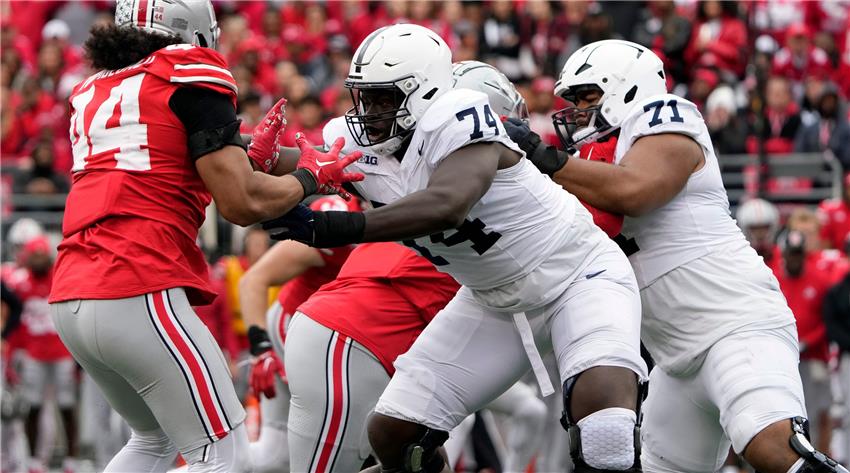
Why Year Three Is the Moment for Eddrick Houston on Matt Patricia's Defense
Every defensive line rebuild needs a player who's already spent two years absorbing the details before being asked to carry a starting role,
and for Matt Patricia's 2026 defense, that player is Eddrick Houston.
Houston arrived at Ohio State as the No. 26 overall prospect and the No. 7 defensive lineman in the 2024 class per 247Sports' composite rankings, choosing the Buckeyes over Alabama, Georgia, USC and a list of other blue-blood programs. He was recruited as an edge rusher, but Ohio State's staff added weight and moved him inside, and the Georgia native now plays as a three-technique pass rusher at 6-foot-3 and 292 pounds, still carrying the get-off and quickness that made him a coveted recruit in the first place.
A Clear Developmental Arc
The production has followed a clear developmental arc. Houston appeared in 12 games as a true freshman before breaking out as a true sophomore in 2025, when he posted 21 tackles, four tackles for loss and three sacks across 13 games. It was enough to establish him as a rotational piece behind Kayden McDonald, but with McDonald now gone as a second-round NFL draft pick, Houston is positioned to become one of Ohio State's primary interior linemen in 2026, working alongside Alabama transfer James Smith and UCF transfer John Walker in a retooled tackle rotation.
The timing lines up with a pattern that's held across college football for years: the third season is typically when a player's physical tools and scheme knowledge finally catch up to each other. "Year No. 3 is when the jump has to happen for players in college, or it typically just isn't going to happen," as one analysis of Houston's outlook put it, framing 2026 as close to a defining season for his career trajectory.
That kind of developmental patience is consistent with how Matt Patricia has talked about coaching since his first spring in Columbus, when he emphasized simplifying complex concepts so players can execute at full speed rather than play hesitant while overthinking assignments. "I think the beauty of football, and definitely something I learned at New England, was take the extremely complex and let's try to boil it down to maybe three to five things, really simple, so we can really detail that out as much as possible," Patricia said during his introduction as defensive coordinator. For an interior lineman like Houston, whose job depends on reacting instantly rather than processing an entire scheme presnap, that philosophy is exactly what makes a Year 3 jump possible.
Why Year Three Matters
Houston's path also reflects the larger story of Ohio State's defensive tackle room in 2026: a mix of a homegrown developmental success story working alongside proven transfer talent, all fighting for reps in a rotation Patricia has built around collective strength rather than one clear headliner. If Houston takes the step his recruiting profile always suggested he could, he gives Matt Patricia's defensive front an interior presence that doesn't have to lean entirely on newcomers to replace what Ohio State lost up front.
There's also a competitive angle that should push Houston even further. James Smith arrived from Alabama with a five-star pedigree and immediate name recognition as the top defensive tackle in the transfer portal, and John Walker brought his own starting experience from UCF. Neither transfer is guaranteed a role over a homegrown player who already knows Patricia's terminology and has a full offseason of reps in the scheme. If anything, that competition is exactly the environment Patricia has said he wants inside the room, one where snaps are earned week to week rather than handed out based on recruiting rankings or where a player transferred from.