

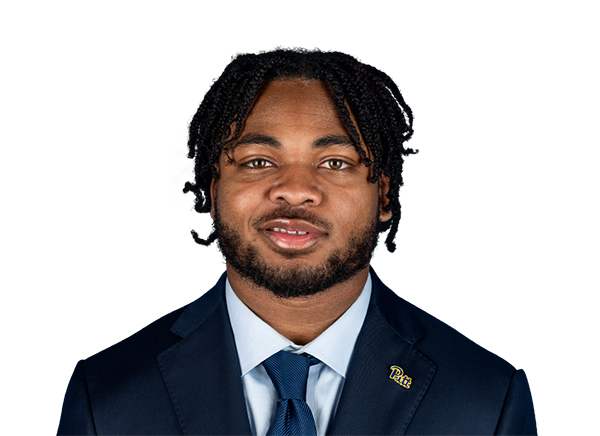
Desmond Reid RB Pittsburgh |
NFL Draft Profile & Scouting Report
| Jersey: #0 ROLE: DUAL-ROLE Back | |||||||||||||||||||||||||||||||||
| Last Updated: 04/01/2026 | |||||||||||||||||||||||||||||||||
| Draft Year: 2026 | |||||||||||||||||||||||||||||||||
| FORTY time: 4.58 seconds (43%*) | |||||||||||||||||||||||||||||||||
|
|||||||||||||||||||||||||||||||||
| Jersey: #0 | |
| ROLE: DUAL-ROLE Back | |
| Last Updated: 04/01/2026 | |
| Draft Year: 2026 | |
| Forty time: 4.58 seconds (43%*) | |
| Overall Rating: | 79.0 / 100 | |
|---|---|---|
| Average rating of opposition Defense player has faced | ||
| Defense Rating: |
|
76% |
| Click the links below to view how player ranks vs other prospects. | ||
| Rushing: |
|
74% |
| Break Tackles: |
|
57% |
| Receiving/Hands: |
|
80% |
| Pass Blocking: |
|
29% |
| Run Blocking: |
|
57% |
|
DRAFT PROJECTION:
UDFA
Overall Rank:
#261
Position rank:
#19 (RB)
|
||
| College Games: 35 College Snaps: 1435 | ||
 247 RATING: 84/100
|
||
| Player Comparison* (Similarity level) | ||
|---|---|---|
| Deuce Vaughn - Kansas State |
|
61% |
| Mohamed Ibrahim - Minnesota |
|
55% |
| Jerrion Ealy - Ole Miss |
|
48% |
Draft Profile: Bio
A three-star recruit out of Miramar High School in Florida, Desmond Reid landed at Western Carolina and earned Southern Conference Freshman of the Year honors in 2022 after rushing for 826 yards and four touchdowns across 10 games. His sophomore season was even better on a per-game basis, averaging over 112 rushing yards and scoring 13 touchdowns in eight contests before injury shut him down. The AFCA named him a second-team All-American despite the limited action.Reid followed offensive coordinator Kade Bell to Pittsburgh in January 2024 and immediately stepped into a featured role. He started 11 games for the Panthers, finishing with 962 rushing yards, 579 receiving yards, and 10 total touchdowns while missing two contests with injury. His 154.9 all-purpose yards per game ranked fifth nationally, and six different outlets named him a second-team All-American in the all-purpose category. He became the first Pitt player on record to post 100 rushing and 100 receiving yards in the same game during a comeback win at Cincinnati.
His 2025 season was derailed by recurring leg and ankle injuries. In seven games, Reid managed 278 rushing yards and 317 receiving yards with four total touchdowns, though he was clearly limited when he did take the field.
Scouting Report: Strengths
- Obvious long speed on tape with the acceleration to pull away from angles
- Short-area quickness allows him to redirect and make tacklers grab air
- Natural hands and route-running instincts out of the backfield
- Creates real problems for linebackers on seam and wheel routes
- Ball security on rushing attempts is excellent across four seasons of tape
- Adds kick and punt return value with two career punt return touchdowns
- Can be aligned in the slot or split wide to create schematic flexibility
Scouting Report: Weaknesses
- At 5-6 and 174 pounds, durability is a constant and fair concern
- Pass protection is a major liability that limits third-down usage
- Yards per carry and after-contact production both declined at the Power Five level
- Not a viable option in short-yardage or between-the-tackles rushing situations
- Tends to hunt for home runs instead of taking what the blocking gives him
- Injury history at both schools is hard to separate from the size concerns
- Decision-making and ball handling on punt returns can be shaky
Scouting Report: Summary
Reid faces a tough roster math problem. At 5-6 and 174 pounds with injuries that cost him time in three of his four college seasons, he is asking an NFL team to invest a roster spot in a player whose body has not held up against college competition. The receiving ability is real and translates on tape, particularly his work on option routes and seams out of the backfield. But a back who cannot protect the quarterback and whose rushing production dropped noticeably when he moved from the FCS to the ACC is not someone who slots into a traditional rotation.The honest conversation about Reid starts with whether he can stay healthy long enough to justify the investment. His 2024 tape at Pittsburgh showed flashes of a movable chess piece in a spread offense, but he missed games that year too. The punt return ability and speed give him a secondary path to a roster, and that versatility matters for a bubble player. Still, history is not kind to backs this small. Even productive college players at his size have struggled to stick beyond a season or two.
The most likely outcome is a training camp invite or late draft selection where Reid competes for a spot as a return man and situational receiving back. If everything breaks right and he stays healthy through a preseason, he could carve out a niche as a change-of-pace option on a team willing to scheme around his limitations. The ceiling is limited, and the floor is a practice squad player whose body cannot handle the workload. That is the reality at this size and with this medical history.
Desmond Reid percentiles vs other Running Backs (NFL Combine historically - higher value represents better perfomance)
How other scouting services rate Desmond Reid (Overall Rank)
All Scouts AverageOverall Rank
262.8
All Scouts AveragePosition Rank
25.0
*Percentile Ranking in Player's Position Group (NFL Combine Historical Data): This percentile reflects how a player's specific statistics rank
in comparison to historical performances at the NFL Combine, specifically within their position group. A higher percentile indicates a better performance.
For instance, being in the 90th percentile for a particular stat means the player outperformed 90% of their peers in that category.
*Similarity Percentage: This percentage is calculated based on a comprehensive analysis of various factors, including height, weight, 40-yard dash times, on-field performance statistics, and overall player rating. The analysis is conducted against our database of draft prospects from 2021 to 2023. This similarity score helps in evaluating how closely a current prospect aligns with past prospects. It is important to note, however, that this score reflects similarities based on college production and attributes, and does not account for eventual success or performance in the NFL.
*Similarity Percentage: This percentage is calculated based on a comprehensive analysis of various factors, including height, weight, 40-yard dash times, on-field performance statistics, and overall player rating. The analysis is conducted against our database of draft prospects from 2021 to 2023. This similarity score helps in evaluating how closely a current prospect aligns with past prospects. It is important to note, however, that this score reflects similarities based on college production and attributes, and does not account for eventual success or performance in the NFL.